How to Make UGC That Converts Into Sales: Hooks, Structure and CTAs
UGC that converts is a video that makes someone who has never heard of the product want to buy it. It is not the most polished video, and it doesn't need a big audience behind it. It needs a hook that stops the scroll, a clear reason to care, believable proof and one obvious next step.
This guide breaks that down into a structure you can reuse for any product, whether you're a UGC creator in Singapore, the USA or anywhere else. No video is guaranteed to sell, and results depend on the product, the offer and the ad around it. These are habits that give a video the best chance.
What does "converts" mean for UGC?
For a brand, a video converts when a viewer takes the action the ad asks for, usually buying or tapping through to the product page. Brands run UGC as ads and compare videos by how many people watch, click and buy. A video that gets a lot of views but no sales isn't doing its job for them.
That is good news for new creators. The brand isn't asking "how many followers do you have?". It is asking "does this video sell?". On commission deals the question matters to you too, because your earnings follow the sales your video drives.
1. Start with a hook that stops the scroll
You have about two seconds. Skip "Hi guys, today I'm going to show you...". Start with the problem, a surprising line or a result, then explain. Some patterns that work across niches:
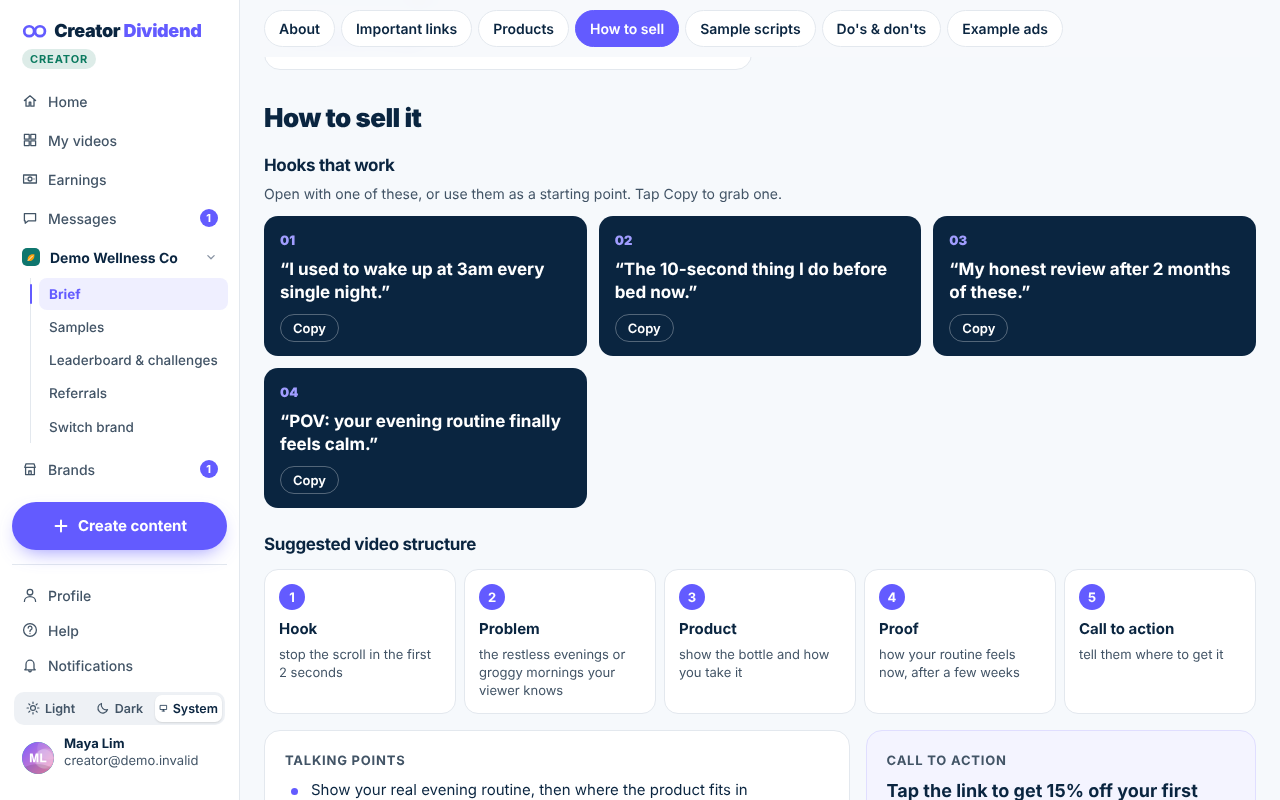
- The problem: "I used to wake up at 3am every single night."
- The habit: "The 10-second thing I do before bed now."
- The honest review: "My honest review after two months of these."
- The point of view: "POV: your evening routine finally feels calm."
These are the kinds of hooks a brand can put in its creator brief. On Creator Dividend, a brand's brief lists hooks that work for its products, and a creator can tap Copy to take one and make it their own.
2. Use a simple five-part structure
Most videos that sell follow the same shape. You can rearrange it, but each beat has a job:
- Hook (first 2 seconds). Stop the scroll.
- Problem. Describe the situation your viewer already knows: the restless evenings, the dull skin, the cluttered desk.
- Product. Show it in your hand and how you use it. Keep it close to the camera and make the label readable.
- Proof. What changed for you, in your own words, after using it. Be specific and honest.
- Call to action. One thing to do next: "Tap the link to try it."
The brief in the screenshot above uses exactly this sequence. Having the beats written down means you spend your energy on delivery, not on deciding what to say next.
3. Show the product early, and show it clearly
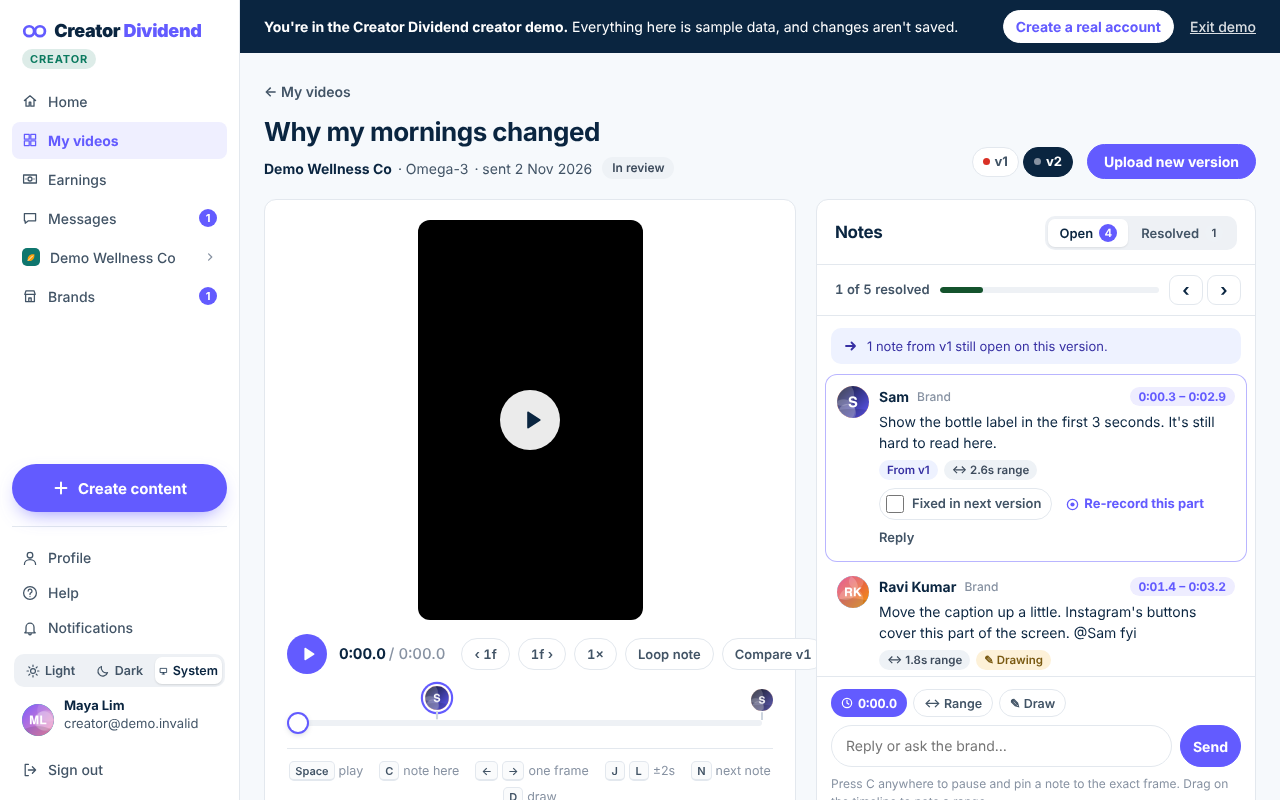
If viewers can't tell what is being sold within a few seconds, they scroll. Hold the product close to the lens early on, turn the label towards the camera and show it being used rather than only held. Brand reviewers often ask for exactly this: a note like "show the bottle label in the first 3 seconds" is common feedback.
4. Make the proof believable
People trust a specific, modest claim more than a big one. "I feel more relaxed in the evening, and winding down after the gym is easier" is believable. "This changed my life" isn't. Say what you noticed, say it's your experience, and don't promise results for everyone.
It also keeps you on the right side of advertising rules. In the US, the FTC's endorsement guidance covers disclosing paid or gifted content and avoiding claims you can't back up. In Singapore, the Advertising Standards Authority of Singapore (ASAS) publishes the advertising code. Health and supplement claims are the most sensitive, so follow the brand's do's and don'ts. This is general information, not legal advice.
5. End with one clear call to action
Tell viewers one thing to do, and say it out loud as well as in a caption. "Tap the link to get it" beats three suggestions. If the brand has an offer, such as a discount on a first order, its brief will usually give you the exact wording to use. Don't invent a discount the brand hasn't approved.
6. Film it so it looks and sounds good
You don't need a studio. The basics make a bigger difference than equipment:
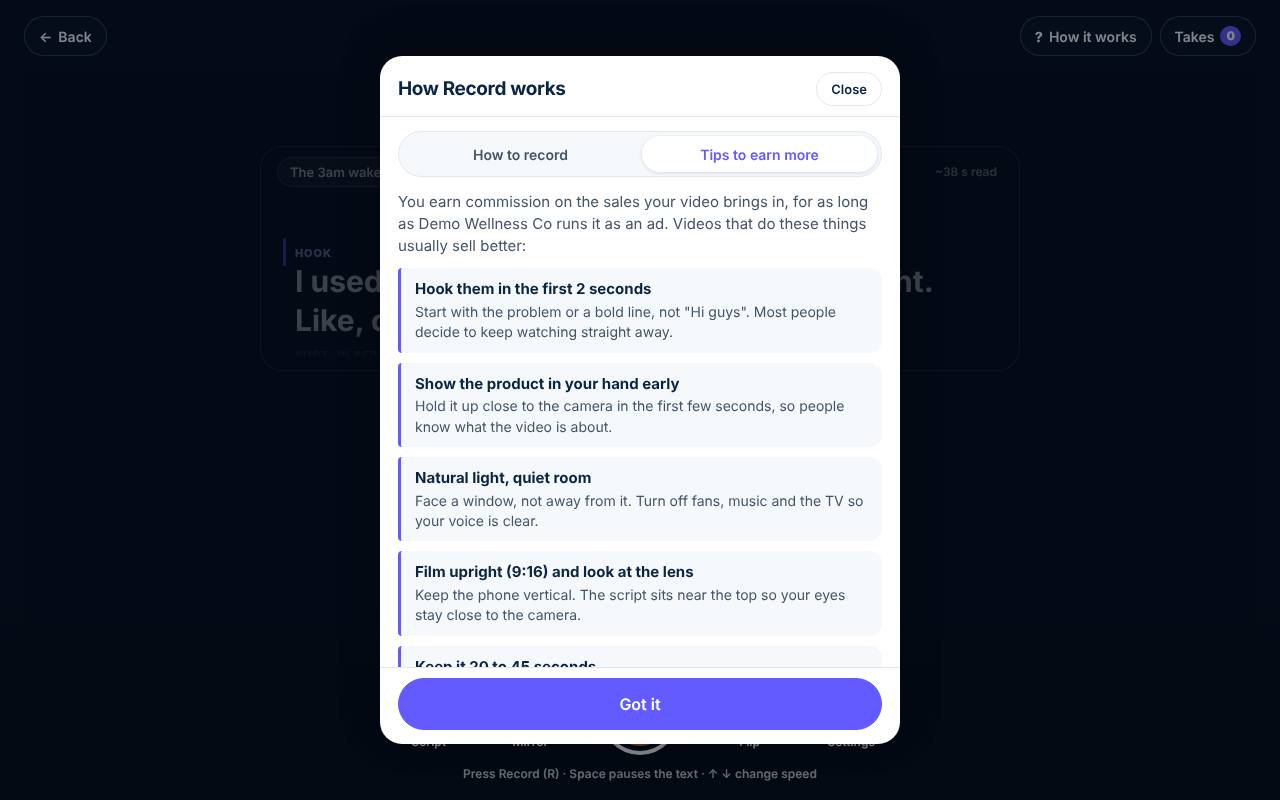
- Natural light. Face a window rather than turning your back to it.
- A quiet room. Turn off fans, music and the TV so your voice is clear.
- Upright, 9:16. Film vertically and look at the lens, not at yourself.
- 20 to 45 seconds. Shorter videos are easier to watch to the end.
Reading from a script helps you look at the lens and stay on message. The Record page on Creator Dividend works as a teleprompter: the script scrolls on screen while you film, and a "Tips to earn more" tab covers the points above.
7. Write a script, then make it sound like you
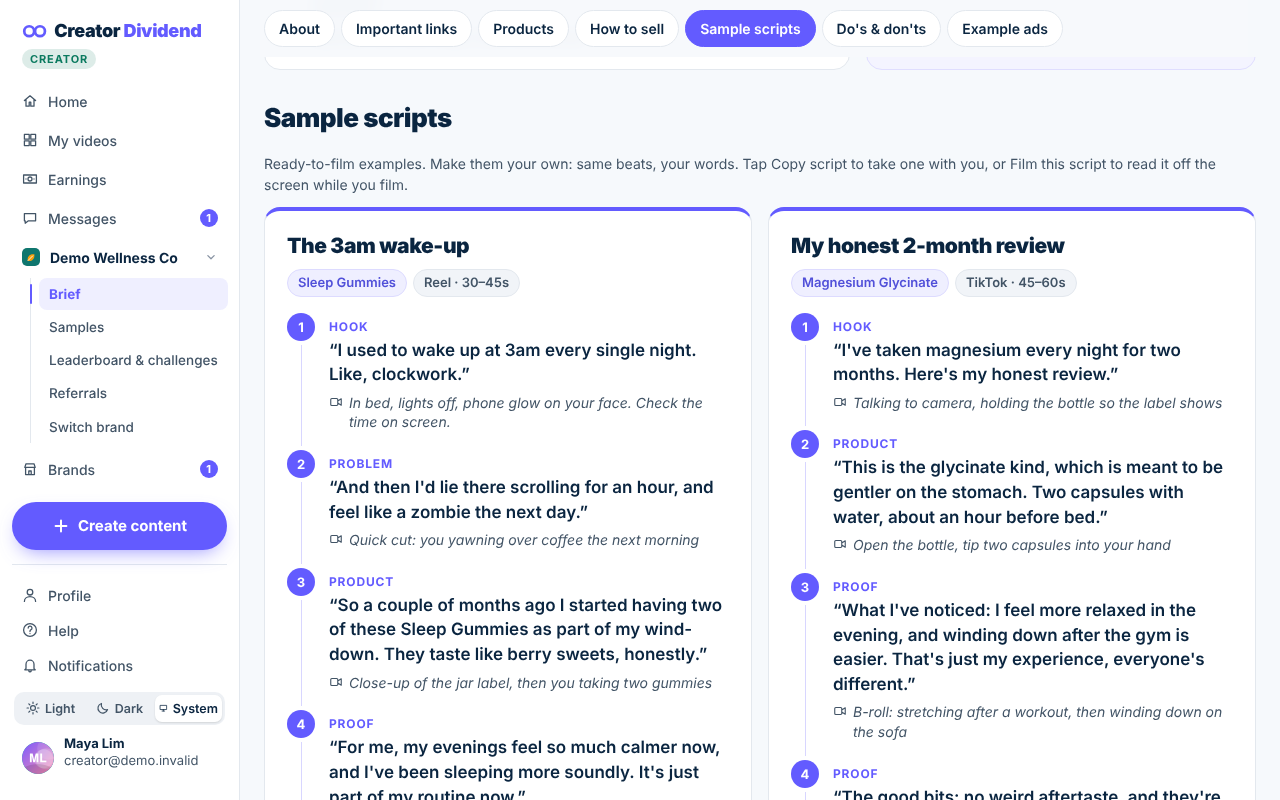
A script keeps you to the structure, but it shouldn't sound read out. Write one idea per line, keep sentences short and say them the way you'd say them to a friend. Ready-made sample scripts help when you're starting. They show the beats and what to film for each, and you change the words to your own.
8. Film several hooks for the same video
The same video with a different first line is a different ad. Brands test several versions at once and keep the ones that perform, so sending three hooks gives you three chances to be the one that runs. You don't have to refilm everything: change the opening few seconds and keep the middle and the call to action.
9. Treat the brand's notes as free coaching
Brands see how videos perform and will tell you what to change. Reading notes quickly and sending a better version is one of the fastest ways to improve. On Creator Dividend, a brand can pin a note to the exact moment in your video, even drawing on the frame, and you can reply, tick off what you've fixed and upload a new version with the open notes carried over.
A quick checklist before you hit send
- Does the first line stop the scroll, without "Hi guys"?
- Can you see and read the product in the first few seconds?
- Is there one clear benefit, with honest proof in your words?
- Is there one call to action, and is it the one the brand asked for?
- Is the light good, the room quiet and the video vertical?
- Is it under about 45 seconds?
- Have you checked the brand's do's and don'ts and any disclosure rules?
Where to practise
You need a product and a brief to practise properly. Create a free Creator Dividend account to get started, then see the brands you can apply to. Creator Dividend is in a closed beta for brands, so the list is still growing and starts in Singapore. If you're not sure where to look in the meantime, the guide to finding brands to work with for UGC has more ideas, and the help centre explains how to make videos that sell more.
Frequently asked questions
What makes UGC convert into sales?
A strong hook in the first two seconds, the product shown early, one clear benefit backed by honest proof, and a single call to action. Good light and clear audio matter more than expensive equipment.
How long should a UGC video be?
Around 20 to 45 seconds works well for most short-form ads, because shorter videos are easier to watch to the end. Follow the brand's brief if it gives a length.
What is a good hook for a UGC video?
Start with a problem ("I used to wake up at 3am every night"), a habit ("the 10-second thing I do before bed"), an honest review or a point of view. Avoid opening with "Hi guys".
Should I film more than one version of a UGC video?
Yes. Brands test several ads at once, so filming two or three different hooks for the same video gives them more to test and gives you more chances to be the version that runs.
Can UGC be guaranteed to sell?
No. Sales depend on the product, the price, the offer and how the brand runs the ad. A good structure improves a video's chances but nobody can promise results.